Book demo

Shift Swapping

What Should Be Considered When Arranging a Shift Swap Between Employees?

Shift swapping

Shift swapping between employees has become an increasingly important way to reconcile professional commitments with personal needs. In the modern workplace, flexible shift scheduling models are gaining more prominence, as they not only enhance employee satisfaction but also improve operational efficiency. However, despite its advantages, shift trading must be carefully planned and executed to comply with legal requirements and organizational needs. 

Content

What Does Shift Swapping Mean? (Definition)

A shift swap (or shift trade) refers to the process by which pre-scheduled work hours are exchanged between two employees. This agreement can be made for personal reasons such as private obligations or scheduling conflicts. Unlike official shift schedule changes initiated by management, shift swaps are typically arranged at the employee level to create more flexibility in working hours. 

In various countries, shift swapping is subject to labor laws and collective agreements to ensure compliance with fundamental regulations such as rest periods and maximum working hours. For instance, in the UK, the Working Time Regulations 1998 provide for minimum rest periods between shifts and regulate overall working hours. Similarly, in the US, while the Fair Labor Standards Act (FLSA) does not explicitly mandate rest breaks, individual states like California impose stricter requirements, including mandatory meal and rest periods. 

Shift Swap Policy and Employment Law

answer mark

Unapproved swaps where employees arrange changes without involving their employer are generally not permitted under labor regulations. Employers often maintain the authority to supervise and approve such changes to ensure they align with operational requirements and legal standards. For example, in the UK, the Working Time Regulations guarantee workers’ rights to adequate rest and limit consecutive shifts. In the US, while federal laws provide guidelines, state-specific laws or collective agreements often govern detailed policies on shift changes. 

Can I Refuse a Shift Change? 

In most cases, management can make official alternatives to the shift schedule if they comply with employment laws and collective agreements. However, employees reserve the right to object in cases of extraordinary difficulties, such as insufficient rest periods between shifts. In the UK and US, employers must balance operational needs against fair treatment of employees, allowing workers to decline unreasonable last-minute requests under certain circumstances.

5 Steps for a Smooth Shift Swap

Successfully swapping shifts requires clear processes to avoid misunderstandings and operational disruptions. The following steps are especially effective:

  1. Agreement Between Colleagues: First, a suitable partner willing to take over the shift must be found. 
  2. Review Legal and Operational Requirements: Every organization requires a clear shift swap policy to ensure that trades comply with local labor laws (e.g., rest periods and maximum working hours). Personal availability and qualifications must be verified. 
  3. Submit Proposal to Management: Any swap suggestion must be presented to the supervisor or the relevant scheduling department. 
  4. Documentation and Approval: All approved swaps should be documented in writing, often using a shift change request form, to maintain transparency and ensure all details are formally recorded. 
  5. Update the Schedule: Ensure the official shift schedule reflects the agreed changes so all stakeholders remain informed. 

Digital tools like the plano WFM solution simplify this process via the myplano tool, where employees can submit swap requests directly, and all updates are documented transparently within the system. 

Reasons for a Shift Trade

The reasons for swapping shifts are diverse, ranging from private commitments to sudden emergencies. 

Employee Reasons  Employer Reasons 
Family obligations (e.g. childcare)  Ensure business continuity 
Health-related needs (e.g. doctor’s visits)  Prepare for peak workloads 
Education: Exams or training  Respond to unexpected staff shortages 

The option to exchange shifts helps create working environments that meet the needs of both employers and employees. 

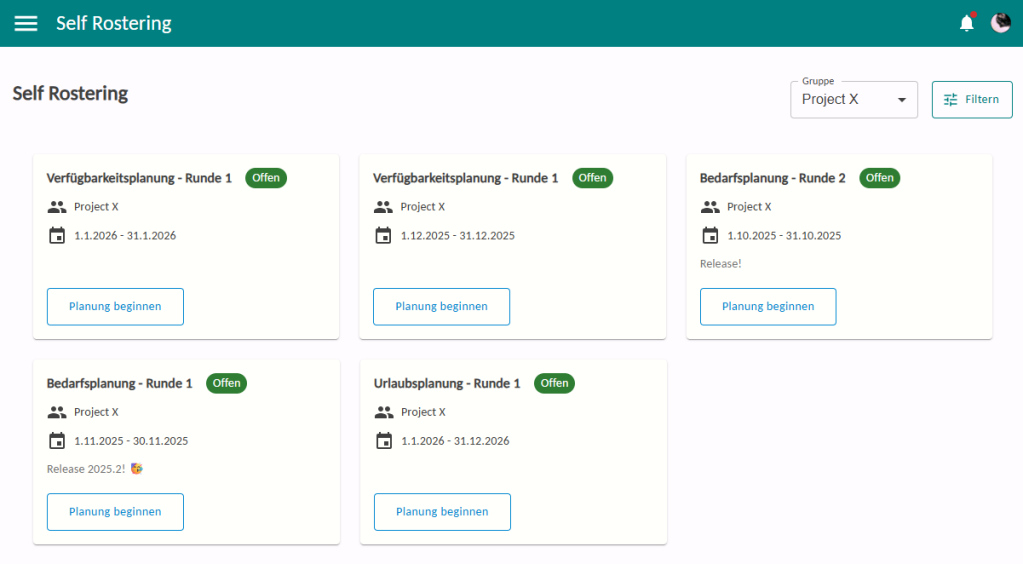
Simple Shift Swapping With plano’s Self Rostering Tool

The Self Rostering module by plano revolutionizes flexible and transparent shift scheduling. Employees actively participate in planning by managing their preferred shifts, unavailability, or swap requests directly through the myplano employee app. This inclusive approach reduces conflicts, as changes are centrally tracked and aligned with company requirements. The system also considers factors like rest periods, qualifications, and fairness-based criteria, such as bonus points for less desirable shifts. Thanks to automatic optimization, the tool ensures fair and efficient shift scheduling without creating additional workload for the HR department.

screenshot of self rostering

 Benefits of Self Rostering 

  • Higher Employee Satisfaction: Employees enjoy better planning security and flexibility, strengthening their work-life balance. 
  • Reduced Administrative Effort: Managers save time as employees can independently make changes. 
  • Fairness and Transparency: Criteria for availability and preferences are processed automatically, preventing inequitable shift distribution. 
  • Flexible Optimization: The system adheres to predefined standards such as qualifications, legal working hours, and operational demands. 

With plano’s Self Rostering, shift swapping becomes simple, transparent, and sustainable, significantly improving overall satisfaction at the workplace.

Risks of Shift Swapping

Even with solid processes, shift swaps can lead to complications if not clearly communicated or documented in time. 

  • Last-Minute Changes: Unapproved or undocumented changes can lead to disorganized schedules. 
  • Lack of Required Qualifications: If the substitute lacks necessary expertise, operational safety may be at risk. 
  • Planning Errors: Failing to include swap agreements in the schedule can result in understaffing or additional overtime costs. 

Checklist for a Correct Shift Swap 

To minimize risks in shift swapping, follow these steps: 

  • Inform all stakeholders about the changes. 
  • Ensure the new arrangement complies with applicable labor laws and guidelines for work hours and required breaks. 
  • Verify that the swap partner is qualified for the role. 
  • Document the changes transparently and in accordance with contractual policies. 

Digital solutions like plano mitigate these risks by offering a streamlined, lawful process with minimal administrative workload. 

Conclusion: Shift Swapping for Better Workplace Climate

A well-organized shift swap improves employees’ work-life balance while boosting operational efficiency. The ability to flexibly adjust and personalize work schedules fosters trust and enhances team morale. 

Modern tools like plano’s Self Rostering make shift swapping straightforward and transparent by considering both employee preferences and organizational needs. Simplify shift exchanges and discover the benefits of our smart software solution today! 

Book Demo

We’re Here for You

Have questions about our products?
We’re here to help.
Frau macht ein Herz mit ihren Händen

Contact

 Let's get in touch and discuss your ideas.

"*" indicates required fields

This field is for validation purposes and should be left unchanged.
Name*
E-Mail*

Please fill in all fields marked with * before submitting the form.

Great to have you here

Work with us to find the best solution for your company too.
Make an appointment now for a free, no-obligation product demo.

Great that you want to meet us

Register now for our roadshow in your area.

Great that you want to meet us

Register now for the plano Campus. Please register each participant individually and with their own email address!

Great to have you here

Work with us to find the best solution for your company too.
Make an appointment now for a free, no-obligation product demo.

"*" indicates required fields

This field is for validation purposes and should be left unchanged.
Name*
E-Mail*

Please fill in all fields marked with * before submitting the form.