




19.10.2026
HR Trends 2026
A fruit basket, a height-adjustable desk, and one day of remote work per week. What was considered a real perk…
Go to article

Employee self-service (ESS) portals enable employees to view and modify certain personnel information in the company themselves.
With self-service, employees are actively involved in the company’s personnel planning and can take on a variety of tasks themselves, from digital vacation requests and shift swapping to submitting applications for parental leave.
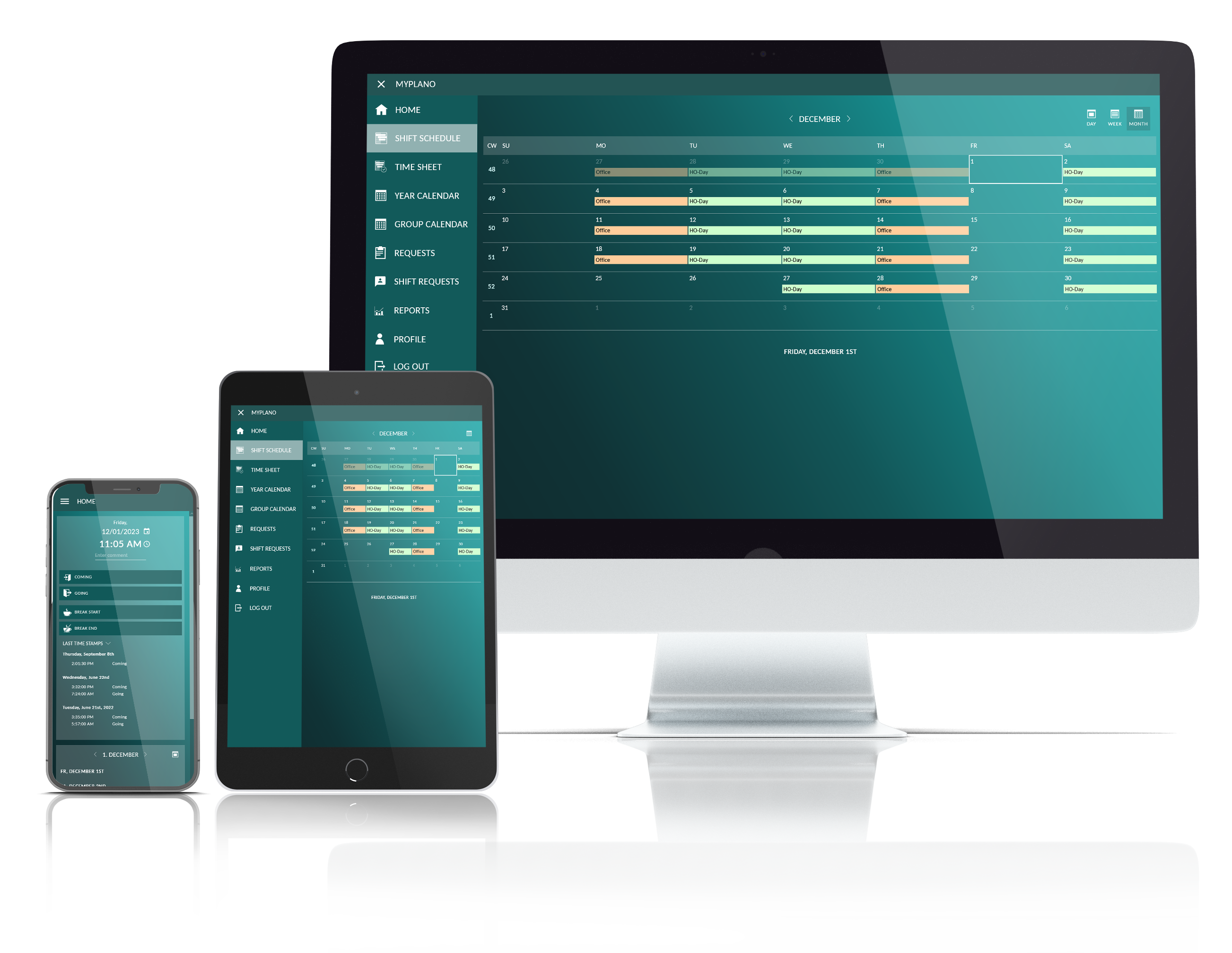
In most cases, a suitable employee portal like myplano also offers the option to view one’s own schedule and, if necessary, adjust it based on their own preferences. At the same time, company, legal, or collective agreement requirements are also taken into account.
A key aspect of employee self-service is to encourage employee engagement. Not only do your employees benefit from transparent personnel planning, but they can also become actively involved themselves. This helps the team feel respected and increases employee satisfaction.
With modern employee self-service (ESS) like our employee portal myplano, your employees will have an app or web application at their fingertips that allows them to easily swap shifts, submit requests, and view their schedules in real time. This high level of flexibility has a positive effect on work-life balance. When employees are able to participate, their level of satisfaction and loyalty increases. Especially during times of staff shortages, this is essential for companies that want to remain competitive.
With employee self-services like our employee app myplano, employees benefit from transparency and flexibility. At the same time, you can also benefit greatly at an operational level from the new standard in human resources. With employee self-service, you inch one step closer to a paperless office, among other things, and conserve resources through features such as digital vacation requests. Administration as a whole also becomes easier, as shift swapping, booking working hours, and plenty of other processes are carried out directly by the ESS system.
With our employee self-service app myplano, you can engage your employees while simultaneously removing the burden from the human resources department. Your employees are able to regulate many aspects themselves and add them directly to the system. The responsible manager only needs to keep an overview of everything and, if necessary, issue approvals or hold consultations.
With our myplano employee self-service, there is plenty of potential for employees and companies. Our employee portal gives your workforce the chance to be involved in staff planning and offers a list of features that improve the employee experience:
Employee Self Service (ESS) and HR self-services refer to digital tools that enable employees to handle HR-related tasks independently without needing direct assistance from the HR department. While ESS focuses more on the user experience from the employee’s perspective, HR self-services are designed primarily to streamline and digitize internal HR processes. That said, both concepts go hand in hand and offer numerous benefits for both companies and their workforce.
One of the key benefits of ESS is time savings for both employees and HR. Instead of sending emails or filling out forms, employees can submit vacation requests, upload sick notes, or update their personal information directly in the system.
ESS solutions also offer 24/7 access to information and features. Whether at the office, at home, or on the go, employees are no longer tied to business hours.
ESS promotes transparency and personal responsibility. Employees maintain control over their data, can track the status of their requests, and experience HR processes as more tangible and transparent.
Automating many of these processes speeds up approvals, improves efficiency, and eliminates the need for paper or manual handoffs. Direct data entry also reduces the risk of errors and enhances data quality.
For HR departments, self-service primarily means relief. Routine questions like “How many vacation days do I have left?” or “Where can I find my pay stub?” are handled directly by employees, reducing the volume of repetitive inquiries.
Self-services also help standardize and automate recurring HR processes from absence management to the generation of official documents.
Another key benefit is access to real-time, up-to-date data that supports informed HR decisions and enables data-driven HR controlling.
Self-services also contribute to cost savings: less paperwork, lower administrative effort, and higher scalability as the company grows all have a positive financial impact.
Last but not least, modern, user-friendly self-service portals boost employee satisfaction by making them feel informed, empowered, and digitally supported.
A major advantage of an employee self-service app is paperless scheduling. Instead of printed schedules, everyone works with a digital, up-to-date overview—updates are made in real time and from anywhere. This eliminates printing and archiving costs, conserves resources, and reduces errors caused by handwritten notes. At the same time, transparency and flexibility increase because employees and management can respond to changes immediately.

myplano —
The Shift Scheduling App
Involve your employees in your shift scheduling. Working hours, shift swapping, and vacation requests made fast, easy, and mobile.
Book Demo


Involve your employees in your shift scheduling and increase staff satisfaction.
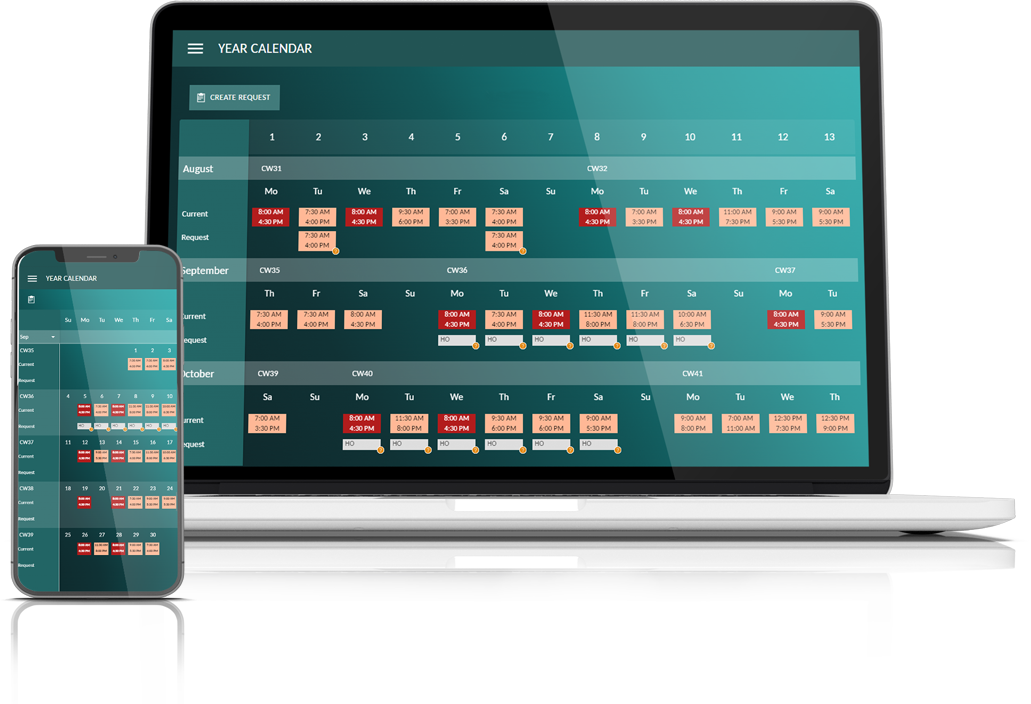
With your smartphone or tablet, you can view and swap shifts or submit requests—whether working from home, in the office, or on the job site. With just a few clicks, your employees can take part in shift scheduling based on the rules you define, helping to create the perfect work-life balance.
With our employee portal myplano, your employees can take over a range of shift scheduling tasks themselves based on the self-service principle, saving human resources a lot of work. Whether vacation planning with pen and paper, inquiries regarding shift schedules, or requests to swap shifts via telephone: with myplano, everything happens digitally and on demand. Regardless of when or where.

3,900,000 users in 33 countries — How we successfully implement workforce management for our customers










Plan vacations easily and quickly using your smartphone – with myplano, your employees can effortlessly submit vacation requests, and planners can approve them without any hassle.

Our 360-degree all-in-one solution for shift scheduling and all personnel processes is used by more than 1 million people worldwide. Discover the other features of our workforce management system:
Employees can digitally request vacation, check vacation statuses and report absences. Manual processes are eliminated and planning becomes easier.
Scheduling is done precisely based on demand. This helps avoid things like overtime and reduces costly overruns.
Your employees can update and manage their data themselves digitally. This reduces errors due to manual data transfer.
Our employee portal myplano gives your employees ownership and transparency over their own work data and processes, increasing engagement and satisfaction.
Your employees take care of tasks themselves, taking work off the shoulders of those in the human resources department.
Extensive information on remaining vacation or overtime, distribution of timesheets, approval for shift swap requests? myplano does everything digitally, saving you time.
We have the right solution for your industry requirements.
Test us! We’ll show you live how effectively plano can be applied to real workplace scenarios.
What’s new at plano?






You take the first step. We’ll take care of the rest.

In our first meeting, we will analyze your current state. Within the scope of an as-is process analysis, we will determine problem areas and discuss initial solution steps with plano WFM.
We define your concrete requirements in a functional specification document, finetune the contents, and plan implementation with plano WFM.
We configure and implement the software based on your requirements. After a test phase, approval and rollout of the system will take place. Even after this step, we will continue to support you with heart and mind.
We’re Here for You