




19.05.2026
5 Myths About Self Rostering
For a long time, traditional staff planning was based on a top-down approach: a planner assigns tasks, and the team…
Go to article

Self Rostering (also known as employee-driven scheduling) is a planning approach in which employees are actively involved in creating their own shift schedules. Instead of a central planning authority assigning all shifts on its own, employees specify their preferred shifts, availability, and swap options themselves. The final schedule is then created through manual or automatic coordination with operational requirements (e.g., minimum staffing, qualifications, working time laws).
Self Rostering shifts part of the responsibility for scheduling to employees, combines their preferences with operational requirements, and thus creates more flexible, often more efficient schedules.
.
The employer establishes clearly defined framework conditions: service requirements such as staffing levels and necessary qualifications, statutory working hours and rest periods, maximum and minimum working hours, break regulations, shift types, restricted periods, and deadlines. At the same time, binding rules on fairness and prioritization are established.
Employees enter their availability, preferred shifts, restricted periods (unavailability), or exchange offers via a digital tool (web, app, or desktop). They can specify specific preferred times, formulate general preferences (e.g., early or night shifts), and indicate their willingness to work overtime or as a substitute.
The system or those responsible for planning compare employee input with the previously defined framework conditions. Availability, qualifications, and legal requirements are checked and verified for compliance with staffing requirements. Any conflicts that arise, such as overbooking or competing preferred shifts, are resolved according to defined prioritization rules.
Algorithms automatically generate schedule proposals that consider staffing requirements, qualifications, legal requirements, and fairness criteria. Those responsible for the schedule review these proposals and make manual adjustments as necessary, for example, in the case of critical shifts or legal restrictions.
The finished shift schedule is published centrally in the tool and made available to all employees, including notifications via push or email. Each person can see transparently which shifts have been assigned and on what basis the assignment was made (e.g., requirements, qualifications, prioritization rules).
Employees post swap offers or release shifts. Swaps take effect automatically upon mutual confirmation or after planner approval. Fallback/escalation rules apply in emergencies (stand-ins, on-call pool).
Planning is continuously monitored: Key figures such as staffing levels, overtime, absenteeism rates, and a fairness index are regularly recorded and evaluated. Based on this data and through targeted feedback loops such as employee surveys or regular consultations with planners, the rules and processes are continuously adjusted to improve quality, legal certainty, and employee satisfaction.
Self Rostering offers many advantages, but also presents a number of challenges. From a legal and collective bargaining perspective, it must be ensured that working hours, rest periods, and collective bargaining requirements are adhered to at all times. This often leads to problems of unequal distribution of workloads or perceived unfairness: rotation principles, points systems, transparent rules, and a fairness index help to avoid frustration. Technical acceptance and usability are crucial, because complicated tools lead to misuse or non-use; an intuitive interface, mobile apps, training, and support promote usage. Poor data quality or outdated availability information cause planning errors, which is why reminders, deadlines, and blocking periods are useful. Integration with time recording, payroll, and HR requires robust APIs and regular testing, while complex qualification requirements necessitate well-maintained competency profiles and automatic checks. For short-term absences, on-call pools, escalation rules, and clear fallback processes should be established. With large numbers of employees, the scalability and performance of optimization algorithms pose a challenge; efficient algorithms, prioritization of critical areas, and batch planning are possible solutions here.
Last but not least, change management is important: early involvement of employees, pilot phases, transparent communication, and training increase acceptance. Finally, data protection and access control must not be neglected: GDPR-compliant processing, role-based rights, and encryption are mandatory. With these measures, Self Rostering can be operated efficiently, fairly, and in compliance with legal requirements.
Self Rostering brings tangible benefits for both employees and companies.
For employees, it increases predictability and work-life balance: they can take availability and preferred shifts into account, have more influence over their working hours, and thus better organize their family, leisure time, or side jobs. This increases satisfaction, motivation, and often also loyalty to the company. Transparent rules and fairness mechanisms reduce frustration, and short-term exchange offers or on-call pools offer flexibility in the event of unforeseen circumstances.
For companies, Self Rostering leads to greater efficiency and better staffing quality: requirements, qualifications, and legal requirements are systematically considered, and miscasting and overtime are reduced. Automated planning processes save planning time and reduce administrative effort. Higher employee satisfaction reduces turnover, sick leave and absenteeism rates can decrease, and employer branding improves. In addition, monitoring metrics (e.g., staffing rate, fairness index) provide data-driven decisions for the continuous optimization of personnel deployment and costs. Overall, Self Rostering creates a better balance between employee interests and operational needs.
Self Rostering is particularly suitable for industries with shift work, variable demand, or specialized qualification requirements.
In general, Self Rostering is particularly effective when several of the following characteristics apply: shift work, variable demand, a high number of part-time or flexible employees, clearly defined qualification profiles, and the need for rapid rescheduling. Branches with very rigid, individually negotiated working hours or extremely small teams benefit less.

Self Rostering
Strengthen Employee Loyalty and Retain Employees Instead of Losing Talent
Book Demo




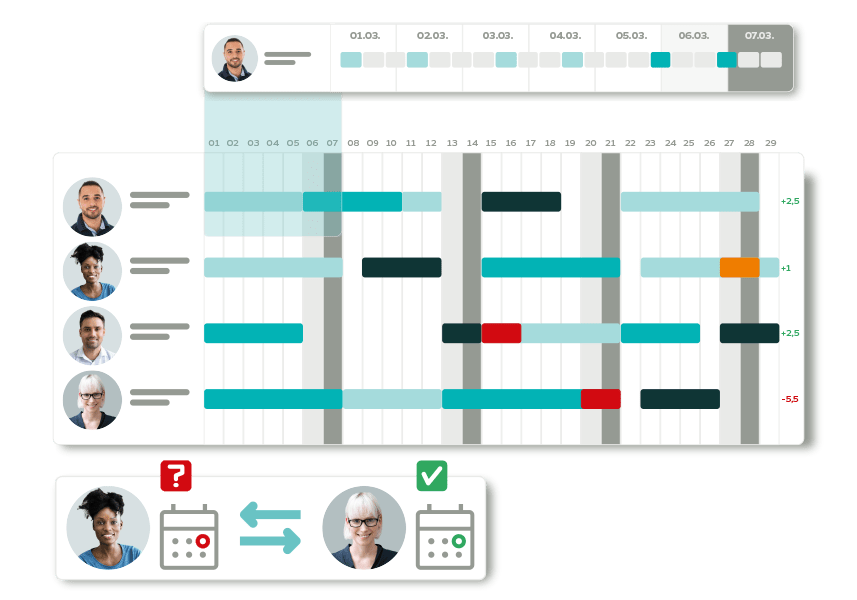
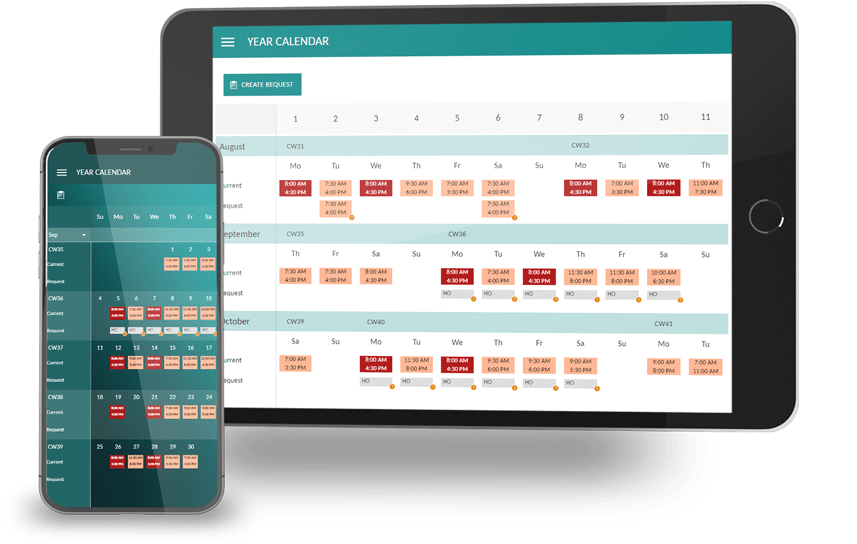
With plano Self Rostering employees gain more influence their work schedule and therefore more flexibility and transparency – all within a clearly defined framework.
Whether it’s shift preferences or short-term changes, team members can actively shape their schedules and find a better balance between work and personal life. By entering preferred times or adjusting working hours directly, employees become co-creators of their shift schedules. The result? A schedule that’s not only optimized (manually or automatically) to meet company needs – but also respects the lives of the people behind the shifts. Because when workforce management works for the people, it works better for the business.
Schedule an appointment and test our flexible workforce management system in practice.


Our 360-degree all-in-one solution for shift scheduling and all personnel processes is used by more than 1 million people worldwide. Discover the other features of our workforce management system:
Effective reduction in planning time by employee participation.
By involving employees at an early stage, shift schedules become more reliable and absences can be better compensated for.
Satisfied employees through participation and positive effects on work-life balance.
Incentive systems for guaranteed all-day and intra-day coverage.
Increase in work quality and productivity through greater sense of responsibility
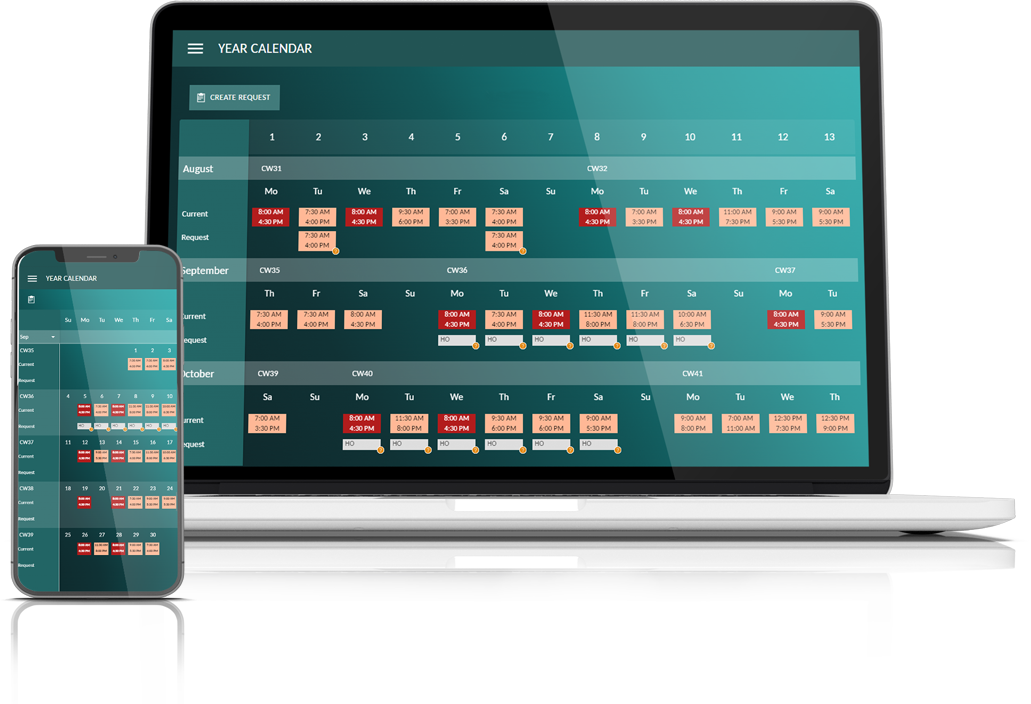
Employee-friendly use on desktop or mobile
We have the right solution for your industry requirements.
What’s new at plano?








You take the first step. We’ll take care of the rest.

In our first meeting, we will analyze your current state. Within the scope of an as-is process analysis, we will determine problem areas and discuss initial solution steps with plano WFM.
We define your concrete requirements in a functional specification document, finetune the contents, and plan implementation with plano WFM.
We configure and implement the software based on your requirements. After a test phase, approval and rollout of the system will take place. Even after this step, we will continue to support you with heart and mind.
We’re Here for You