
Book demo

Absence Management in Nursing

Absence Management in Nursing: The Exceptional Case That Isn't One

Absence Management in Nursing

An Emergency Plan for the Everyday Normal
In healthcare, there is an emergency plan for almost everything: for fires, power outages, mass casualty incidents. And then there is a case that occurs as regularly as a shift change, and for which many facilities have nothing more than a phone list and the phrase: “Hey, can you quickly cover a shift?” 

We are talking about staff absences. 

We like to call it an “exception,” a “bottleneck,” or an “unfortunate chain of events,” even though it should have been factored into every shift schedule in the world long ago. If you have an emergency twice a week, it’s no longer an emergency, it’s an organizational problem. And this is precisely where professional absence management in nursing comes in: to finally turn daily reacting into reliable, forward-looking action. 

Content

Definition: What is absence management in nursing?

Absence management in nursing (as well as across the entire healthcare sector) refers to the totality of all strategic, organizational, and technical measures for the systematic compensation of short-term and unforeseen staff absences (e.g., due to illness or emergencies). 

The goal of a professional absence concept in nursing is to: 

  • Reliably secure minimum staffing levels and specialist quotas 
  • Maintain the quality of care 
  • Protect core staff from overload caused by constantly “stepping in on days off” 

Particularly in elderly care and hospital settings, such a concept bridges the gap between roster reliability and employee health. 

Why do current figures make absence management in nursing indispensable?

Because absences are not an exception, they are a statistical certainty. 

Nursing staff are absent significantly more often and for longer periods on average than employees in other industries, especially in care and often due to high psychological strain. Those who ignore this reality and treat absences as rare emergencies overload the remaining team and trigger a dangerous downward spiral. 

How drastic the difference to the general job market is becomes clear from the analysis by Techniker Krankenkasse: 

Sector / Occupational Group  Ø Absence Days per Year 
Geriatric / Elderly Care  32.7 days 
Nursing Staff Nationwide  27.8 days 
Hospital Nursing  25.8 days 
National Average (all occupations)  17.7 days 
Of which mental illnesses (Nursing RLP)  6.3 days (vs. 3.3 days avg.) 

Source: Fehlzeiten von Pflegekräften | Die Techniker – Presse & Politik 

If you calculate that out, the statistics quickly become a scheduling problem: A difference of ten absence days per capita equals around 1,000 additional absence days per year for every 100 employees. These days don’t just disappear; they have to be covered by someone. And that raises the genuinely interesting question: by whom? 

How does a fair absence management concept work in practice?

answer-mark

Five Stages of an Absence
Anyone taking this topic seriously should view it as a process, not an isolated event. Between the initial sick call and a fully covered shift, a lot happens—and at every stage, time is lost or fairness goes down the drain: 

  1. Recognize: When and how does the planner learn about the absence, and how quickly is the gap visible on the schedule? 
  2. Screen: Who would be eligible? Who has the required qualification, who is available, and who still has sufficient rest time? 
  3. Inquire: Whom do I contact, in what order, and through which channel? 
  4. Assign: Who accepts, and how does this update get reflected in the roster? 
  5. Evaluate: What does this absence teach us for the next one? 

In everyday practice, the first four stages often blur into a single phone marathon. Experience shows that the fifth step doesn’t happen at all because the next call is already waiting. 

“As long as someone shows up”? Not quite.

On top of that, there is a persistent myth: Main thing is, the shift is covered. In healthcare, that is rarely the whole truth: 

  • An intensive care unit requires different competencies than a residential ward 
  • The operating room requires different competencies than adult day care 
  • Emergency medical services require different competencies than an outpatient clinic 

Minimum staffing levels, specialist quotas, and certifications still apply even if someone agrees to step in at five minutes to six. 

A gap is never just a gap; it is a gap with a specific job profile. Planners who do not have full visibility of their team’s qualifications at a glance will either call the wrong people or overlook the right ones. Cleanly maintained skill management and qualification management are not administrative gimmicks; they are the baseline requirement for absence management to function accurately.

The Chronic Savior and Other Injustices 

Every team has one: that one colleague who never says no. She or he are is reachable, helpful, and loyal. And for that exact reason, she or he gets asked most often. The result is an injustice that nobody intended, yet everyone feels: 

  • Those who are reliable get penalized. 
  • Those who turn off their phones suddenly enjoy their personal lives more. 

Fair distribution therefore does not mean asking everyone with equal frequency. It means transparently factoring in availability, working-hour accounts, past fill-in shifts, and individual preferences—in such a way that everyone understands why they are being contacted. Here, transparency is not a nice-to-have; it is the difference between “I’m happy to help” and “Why me again?” 

young women

How does a float pool concept in nursing solve the problem of bottlenecks?

Pooling: When Not Every Absence Has to Be an Isolated Emergency

One of the most effective responses to perpetual stopgaps is a concept that has long been standard in industry but is still too rarely applied in healthcare: Why not create a shared resource instead of having each ward beg for replacements on its own? 

A staff pool bundles employees with similar qualifications who are not permanently tied to a single unit, but are deployed flexibly wherever a need arises. This relieves individual unit managers of the burden of solving every absence alone. It also shifts the mindset from “My ward, my problem” to “Our organization, our shared resource.” A detailed introduction can be found in our plano article Pooling with WFM Software. 

Pooling with plano

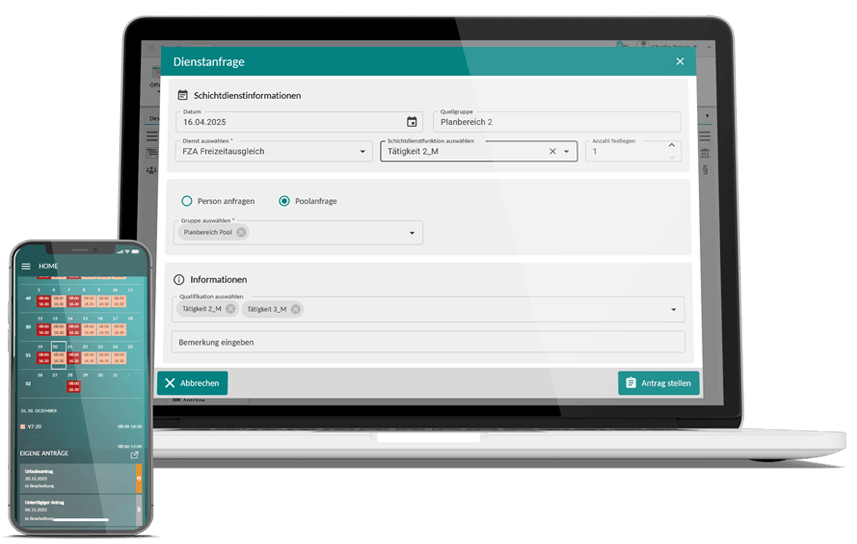
With plano Pooling, employees with similar qualifications can be pooled together and flexibly distributed to open shifts. The system matches qualifications, availability, and individual preferences, suggesting optimal staffing assignments. Employees receive an inquiry via push notification and can accept the shift directly. The result: fewer phone calls for planners, less reliance on expensive agency staff and short-notice overtime, and greater fairness in shift allocation. 

Having a say increases willingness to step in

It stands to reason that the willingness to step in is closely linked to how much influence employees otherwise have over their own schedules. Those who can input preferences, swap shifts, and view open shifts independently experience short-notice assignments more as a personal choice rather than an unreasonable demand. 

This is precisely where the employee portal myplano comes in: availabilities and preferences are recorded digitally, feed automatically into planning, and are also considered during pooling. For those wanting to take it a step further, Self-Rostering offers a model where teams design their schedules more autonomously. Whether this works for every organization is a matter of culture and preparation (the works council should be involved early on). As a conceptual model, it is well worth exploring. 

How does absence management turn from a makeshift solution into a forward-looking strategy?

Learning to Read the Gaps
And then there is Stage Five, which gets forgotten so easily. Those who evaluate absences systematically will detect patterns: 

  • Are absences noticeably frequent on Monday mornings? 
  • Are shortages accumulating in one specific department? 
  • Does the schedule regularly collapse in November? 

These insights are worth their weight in gold when fed back into subsequent planning cycles.
A thorough staffing requirements analysis helps identify actual demand, while AI-supported schedule optimization ensures that rosters are resilient right from the start. 

The goal is not a roster without absences (which doesn’t exist), but one capable of withstanding them.

Sustainable workforce management – young woman from healthcare.

One Topic, Many Settings

Whether hospital, nursing home, home care, rehabilitation facility, outpatient center, or medical practice: the stage differs, but the story remains the same. 

  • In hospitals, on-call duties and a wide variety of qualifications come into play 
  • In inpatient care, round-the-clock minimum staffing rules apply 
  • In home care, extreme time pressure dominates 
  • In small practices, any single absence is felt immediately 

This is precisely where plano WFM provides support, already being deployed successfully by leading healthcare providers like Vivantes. You can find more about the industry on the page plano for Healthcare and in the comparison The 7 Best Workforce Management Solutions in Healthcare.

Back to the Phone

Back to the phone list: It has served faithfully for decades, and no one should take that away from it. But it is a tool for a world where absences are rare. In the world we work in, they are the rule. 

Absence management is therefore less a matter of having an emergency plan and more a matter of mindset: Do we plan for everyday operations as standard operations? Do we treat our teams’ time off as an operational buffer or as what it truly is? And are we willing to learn from every absence rather than merely surviving the next one? 

If you would like to see how open shifts can be filled digitally, fairly, and quickly, schedule a non-binding demo. 

Carolin Holstein, Marketing & PR, plano solutions gmbh

Carolin Holstein

Marketing & PR

Carolin Holstein manages the editorial content of this blog and works in the Marketing/PR field. With her clear, audience-oriented language, she presents complex topics in a comprehensible and practical manner. Through her regular creation of editorial content, she has built extensive knowledge in workforce management, combining marketing expertise with professional depth.

We’re Here for You

Have questions about our products?
We’re here to help.
Frau macht ein Herz mit ihren Händen

Contact

 Let's get in touch and discuss your ideas.

"*" indicates required fields

This field is for validation purposes and should be left unchanged.
Name*
E-Mail*

Please fill in all fields marked with * before submitting the form.

Great to have you here

Work with us to find the best solution for your company too.
Make an appointment now for a free, no-obligation product demo.

Great that you want to meet us

Register now for our roadshow in your area.

Great that you want to meet us

Register now for the plano Campus. Please register each participant individually and with their own email address!

Great to have you here

Work with us to find the best solution for your company too.
Make an appointment now for a free, no-obligation product demo.

"*" indicates required fields

This field is for validation purposes and should be left unchanged.
Name*
E-Mail*

Please fill in all fields marked with * before submitting the form.