
The Master Schedule as the Foundation of Shift Scheduling

Creating a master roster is a central task in staff planning. As the fundamental framework of shift scheduling, the master roster provides planning security for managers and employees alike, helps ensure compliance with legal and contractual requirements, and forms the basis for automated planning processes through Workforce Management (WFM) systems. It provides transparency about the required staffing levels for different times of the day and night, the qualifications that need to be maintained, and how to accommodate holidays, leave, and absences.
Content
What is a Master Roster? (Meaning)
When creating master rosters, it is essential to comply with employment law and relevant agreements. Here is a list of the most important key legal aspects in selected countries:
| Category | Spain | Italy | Belgium | Turkey | Australia |
| Primary statutory basis | Estatuto de los Trabajadores (Workers’ Statute) + implementing rules + collective agreements | Legislative Decree 66/2003 (transposing EU Working Time Directive) + national labour code + collective agreements | Belgian Labour Code (Working Time rules), collective agreements (sectoral CBA often decisive) | Turkish Labour Law No. 4857 and associated regulations | Fair Work Act 2009 (National Employment Standards), modern awards and enterprise agreements |
| Maximum average working hours per week | Common planning benchmark: 40 hours ordinary work per week (averaging permitted by statute and by collective agreement; reference period can vary). | EU limit principles apply — commonly 48 hours weekly averaging including overtime (reference/averaging period and limits set in law/CBAs). | Standard full‑time hours typically 38 hours/week in practice; EU 48‑hour average ceiling applies with national/sectoral variation. | Normal weekly working time: 45 hours (usually spread over max 5 working days); averaging and overtime rules apply. | Ordinary hours: 38 hours/week (NES); additional hours must be “reasonable” and are governed by award/enterprise agreement. |
| Daily rest between shifts | Generally at least 12 hours between workdays under national law (sectoral rules may vary). | Minimum 11 consecutive hours daily rest (consistent with WTD implementation). | Minimum 11 consecutive hours daily rest (WTD rules transposed). | Minimum 11 hours daily rest standardly required. | No single national statutory minimum in the NES for daily rest hours; modern awards/agreements typically provide meal and rest break entitlements and rostering standards — check the applicable award/agreement. |
| Weekly rest | Minimum weekly rest is commonly one full day plus a half‑day (36 consecutive hours) every week (often interpreted as Sunday + half day); sectoral differences possible. | Minimum weekly rest of 24 consecutive hours, with additional protections from sectoral rules—WTD principles apply. | Weekly rest: generally at least 24 consecutive hours per 7‑day period; many arrangements provide for 48 consecutive hours in 14 days by agreement. | Minimum weekly rest: at least one day (continuous rest) per week; statutory weekly rest day provisions apply. | Weekly rest and rostering largely determined by the applicable modern award/enterprise agreement; many awards specify minimum break between shifts and minimum weekly days off. |
| Breaks during shift | Statutory/collective minima (commonly 15–20 minutes for >6 hours; many CBAs set 20 minutes). | WTD minimum 20 minutes if work exceeds 6 hours (national law and CBAs typically enforce this). | Minimum rest breaks in line with WTD — typically 20 minutes after 6 hours; sectoral CBAs may give longer breaks. | Meal/rest break entitlements are regulated; common practice requires breaks on shifts exceeding certain lengths and overtime rules apply. | Breaks and unpaid/paid meal breaks are generally specified in the relevant modern award or enterprise agreement (most awards require a meal break after around 5–6 hours). |
| Night work rules | Night work defined by national law/CBAs (typical night period 22:00–06:00); special protections and limits on consecutive night shifts in many sectors. | Night work subject to WTD limits (average 8 hours per 24‑hour period) and national/sectoral rules on health surveillance and limits on consecutive nights. | Night work governed by WTD rules and national implementation; sector agreements typically specify limits and premiums. | Night work defined and regulated; special protections and premiums may apply; limits set by law and CBAs. | Night and shift work detailed in awards/agreements; rostering must observe higher penalty rates, rest requirements and fatigue risk management in safety‑critical industries. |
| Young workers (minors) | Minors have stricter hour limits and rest rules; night work generally prohibited for younger age brackets; detailed by national law/CBAs. | Young workers have stricter working‑time limits and night‑work prohibitions per national law implementing WTD. | Young worker protections in national law: lower daily/weekly limits and prohibition or strict limits on night work. | Special protections for minors (shorter hours, no late night work) under Labour Law. | Young workers have specific restrictions under NES and awards (limits on hours and prohibited night work depending on age). |
| Overtime, averaging and reference periods | Overtime and averaging governed by Estatuto and CBAs — annual/other reference periods used; premiums generally mandated by CBA. | Overtime regulated by national law and CBAs; averaging periods and overtime premium rates set in law/collective agreements. | Overtime pay and averaging regulated by Labour Code and sectoral CBAs; reference periods may vary. | Overtime pay required by law; statutory annual limits on overtime hours may apply; overtime premium rates set in law. | Overtime and averaging controlled by modern awards/agreements; “reasonable” additional hours standard under Fair Work Act applies and award conditions determine overtime/penalties. |
| Collective agreements / consultation | Strong role for collective bargaining — CBAs often prescribe detailed rostering and rest/shift rules; worker representation in larger firms. | Strong collective bargaining tradition; many rostering details are in national or sectoral CBAs and works councils/OSHA‑style consultation structures. | Sectoral/social partner bargaining is influential; works councils/CPPT may be involved in consultation on rostering. | Trade unions/CBAs play a role where organised; works council structures less formal than EU but consultation obligations exist in many cases. | Awards and enterprise agreements have primary force; consultation/representation required under workplace laws and for safety/changes to roster arrangements. |
Advantages and Disadvantages of a Master Roster
The implementation of a framework work schedule can have both advantages and disadvantages for employers and employees.
Advantages of a Master Roster
- Planning Stability: The master roster defines the basic framework and provides managers with a reliable basis for staffing decisions.
- Transparency: Employees know what shift types and distributions to expect; fair rules for weekend and night shifts reduce conflicts.
- Reduction of Overtime: Recurring structures and forward-looking capacity planning help reduce overtime hours.
- Legal Compliance: Working time regulations and contractual requirements are systematically incorporated.
- Basis for Automation: WFM tools like plano can build on the master roster to automatically generate efficient duty rosters.
Disadvantages of a Master Roster
- Ongoing Maintenance: Regular updating of master data (e.g., FTE, qualifications) and adaptations to changing conditions are necessary.
- Limited Flexibility: Standardised frameworks may be less accommodating of individual preferences and can be perceived as rigid. Individual employee preferences can be managed using plano’s workforce management software.
- Risk of Incorrect Demand Assessment: Outdated or inaccurate data may lead to over- or understaffing. Workforce management software with AI-driven forecasting can help optimize staffing levels.
What Does a Master Roster Look Like?
A master roster should not be a rigid document but an organised, modular framework capturing key planning rules and requirements for the roster period. Typically presented as tables or dashboards in WFM software, its main components include:
- Shift Models and Time Frames: Listing all shifts (e.g., early, late, night, on call, weekend blocks) with start/end times, breaks, and special notes (e.g., handover windows).
- Target Staffing per Shift and Qualification Requirements: Number of required personnel per shift, broken down by qualification levels.
- Work and Rest Day Structure: Rules on maximum consecutive working days and the number of rest days following working periods.
- Weekend, Holiday, and Exceptional Case Policies: Distribution of weekend and holiday shifts, handling of leave and training, policies for sickness coverage and escalation procedures.
- Flexibility Clauses and Escalation Rules: Definitions of acceptable deviations, buffer FTEs, approval workflows for last-minute changes, and staff prioritisation (e.g., qualifications over preferences).
- Documentation and Version Control: Responsibilities, validity periods, and change logs.
Master Roster Template for Healthcare
In healthcare, master rosters typically incorporate 3-shift systems. A typical example for a general ward in a 30-bed hospital might be:
| Shift | Time | Staffing Requirement | Qualification Profile |
| Early Shift | 6:00 AM-2:00 PM | 6 | At least 3 qualified nurses |
| Late Shift | 2:00 PM-10:00 PM | 5 | At least 2 qualified nurses |
| Night Shift | 10:00 PM-6:00 AM | 3 | 1-2 qualified nurses depending on patient acuity |
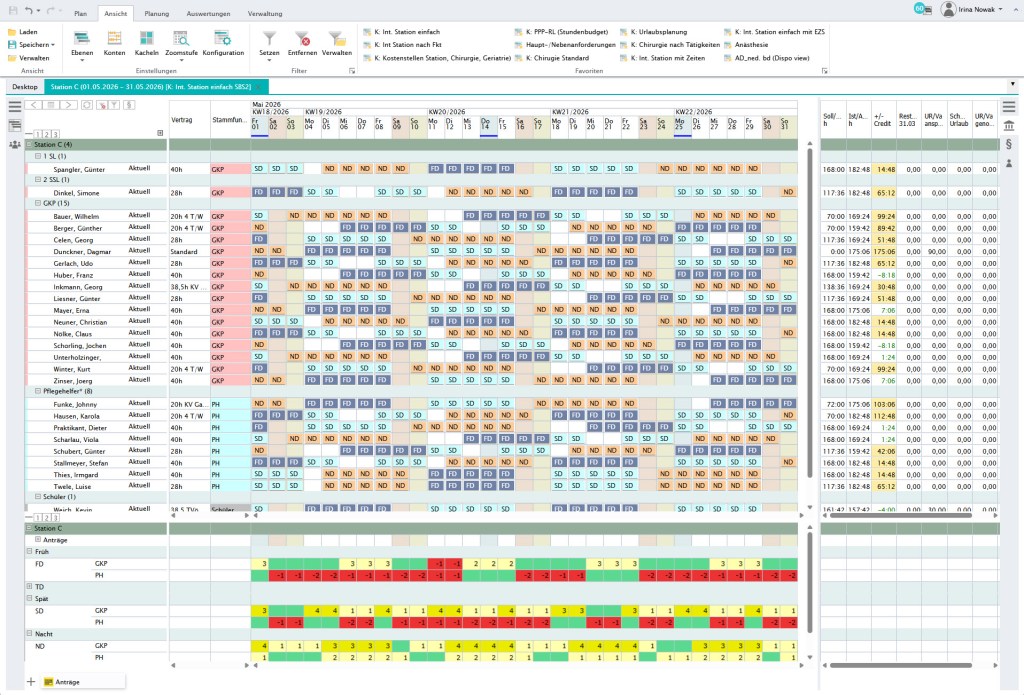
Creating a Master Roster: Step-by-Step Guide
To successfully implement a master roster, follow these steps:
- Assess Staffing Needs: Generate forecasts using historical data.
- Select Planning Period: Typically 4 or 8 weeks, depending on organisation size and agreements.
- Check Legal Requirements: Incorporate the Working Time Regulations, relevant contracts, and requirements for employee consultation.
- Define Shift Models: Establish shift types, start/end times, breaks, and on-call arrangements.
- Set Staffing and Qualification Levels: Determine minimum cover per shift and necessary qualifications.
- Define Fairness and Preferences: Establish rules for weekend shifts distribution and mechanisms for considering employee shift preferences.
- Run Simulations: Test scenarios including increased absence (e.g., 10–15% sickness rates).
- Document and Approve: Version control and align with management and employee representatives; consider formal agreements if necessary.
- Implement: Import the master roster into WFM software as a base for concrete rosters.
- Regular Review: Analyse key performance indicators and adjust at least yearly or when significant changes occur.
Conclusion
A well-thought-out master roster is the foundation of reliable staff planning: It ensures legal compliance, predictability, and fair shift allocations. While rule sets and tables can represent the framework, it becomes truly effective when it is data-driven, simulation-ready, and automatable.
With plano, you create your master roster based on data-driven demand forecasting, embedded shift and qualification profiles, rules for rest periods and weekend allocations, buffer staffing, and escalation pathways. The software then automatically generates rolling, personalised shift schedule compliant with working time laws and contracts of the respective region or country. This saves time, reduces overtime, and makes planning transparent and fair.
Request your free demo today:
We’re Here for You