
Annual vacation planning that works: 5 elements for stable shift schedules and happy airport employees

Annual vacation planning for airport staff is a key strategic tool that determines whether airport operations remain stable over a twelve-month period or whether bottlenecks, overloads, and pressure to improvise become part of everyday life. While other industries can often organize their holiday planning within relatively calm structures, airport operations are constantly caught between flight schedules and their constant changes, seasonal peak loads, and a multitude of specialized roles with qualifications that are not interchangeable.
Anyone who works at an airport knows that operations never stop. The night is not a time for rest, but rather a time for cargo handling, maintenance work, and preparations for the next day. Also school holidays and public holidays are not considered a calm time, instead they are are among the busiest days of the year. In this environment, vacation planning takes on special significance, as it must ensure periods of rest without compromising operational performance. This is a challenge that requires both experience and precise planning, and at the same time demonstrates how essential clear structures, fairness, and the use of the right tools are for the functioning of a highly complex transport system.
Contents:
↓ Why Annual Vacation Planning Is Particularly Complex for Airport Employees?
↓ When to Schedule Annual Vacation Planning at the Airport and How to Organize It Effectively?
↓ What Determines the Priority Order for Holiday Requests?
↓ Workforce Management Software: A Crucial Element for Airport Annual Vacation Planning and Its Key Functions
Why Annual Vacation Planning Is Particularly Complex for Airport Employees?
At first glance, you might think that holiday planning is the same everywhere. Submit a holiday request, hand it in, get it approved, done. But anyone who has ever worked at an airport knows that it’s not quite that simple here. Airports are among those businesses that literally never close. 24 hours a day, seven days a week, 365 days a year.
This means that every holiday request has to fit into a system that knows almost no breaks. Added to this is the complexity of the tasks involved. While ground staff are in high demand at check-in, especially during peak times, security checks are subject to statutory minimum staffing requirements that must be met at all times. Ramp personnel require sufficiently trained staff for loading and unloading. Aviation security management must be ready for action at all times, and the airport operations team must never be understaffed for safety reasons.
These dependencies mean that every day a team member takes off work has an impact on the entire process. A sophisticated planning system and the associated digital tools are therefore essential. At the same time, legal requirements, collective agreements, company agreements, and individual requests must be considered. Not to mention the “peak seasons,” i.e., the holiday periods when most people would like to take time off, but at the same time, the airport is at its busiest.
When to Schedule Annual Vacation Planning at the Airport and How to Organize It Effectively?
The right time for annual planning depends on the individual processes at the airport and the company’s business cycles, but as a rule of thumb, the earlier you start, the better. Many organizations use the fall of the previous year to prepare for the next twelve months, as this leaves sufficient time to build capacity, provide further training, coordinate holiday requests and special events (e.g., holiday periods, major events, expected peak flights), and plan for internal and external changes.
A sensible process begins with a thorough analysis of the past year: monthly flight frequencies, recurring bottlenecks due to sick leave, particularly sensitive weeks, and previous staff shortages should be documented. This data forms the basis for realistic forecasts and helps to identify critical periods at an early stage. On this basis, holiday quotas are set, i.e., how many employees in which area are allowed to take time off at the same time, broken down by team, role, and qualification groups. Such quotas prevent overbooking in key areas and ensure that important qualifications are always represented.
At the same time, a binding deadline for submitting holiday requests should be communicated; for main holidays, four to twelve weeks’ notice is standard, while for the summer months or popular periods, a longer deadline may be appropriate. Modern, digital workforce management software can make implementation much easier: it can automatically consideration qualifications, working hours, remaining vacation time, and target staffing levels, highlight conflicts, and generate alternative suggestions.
Transparent communication is essential here: employees need clarity at an early stage about which requests have been approved or rejected and for what reasons. Open information about the basis for decisions, priorities, and possible alternatives (e.g., postponements or flexitime solutions) reduces frustration and promotes acceptance. Finally, it is important to consciously plan for buffers and take a pragmatic approach to readjustment. Even the best plan will have to be adapted again and again in airport operations, for example, when flight schedules change, emergencies arise, or additional resources are required. Regular review meetings throughout the year help to incorporate findings into the next planning season and continuously improve planning practices.
5 elements for stable shift schedules

The right timing:
Start annual planning early (e.g., 6–9 months in advance) and schedule interim deadlines for corrections and approvals to minimize last-minute conflicts.

Thorough analysis of the past year:
Evaluate absence patterns, peak phases, overtime, and bottlenecks and use them as a basis for realistic planning assumptions.

Binding deadline for submitting holiday requests:
Clear deadlines create planning security and simplify fair prioritization when competing requests arise.

Transparent communication:
Disclose rules, priority criteria, and the status of requests—ideally automatically so that decisions remain traceable.

Use digital tools:
Use WFM software and interfaces to time management/shift scheduling to identify bottlenecks, calculate alternatives, and reduce manual errors.
What Determines the Priority Order for Holiday Requests?
Fair distribution of holiday time requires clear guidelines so that both the personal needs of employees and operational processes are considered. Instead of rigid individual decisions, a transparent system helps to avoid conflicts and improve team satisfaction, rather than the popular “first come, first served” approach.

Key principles that have proven successful in many companies are:
Family responsibilities
Length of service
Social urgency
Flexibility and commitment
Rotation or compensation principle
Compensation for unfulfilled requests
Special occasions
For these criteria to work, transparency is crucial, as is software that these criteria consideration: clear rules, a documented basis for decision-making, and open communication create trust. Support tools or digital planning can further simplify the process and increase traceability.
Workforce Management Software: A Crucial Element for Airport Annual Vacation Planning and Its Key Functions
Efficient planning of employee holidays is crucial to the smooth operation of an airport. In an environment that operates around the clock, that is subject to seasonal fluctuations, and that has to coordinate numerous safety-related and qualification-related tasks, manual holiday management quickly reaches its limits. Workforce management software (WFM) offers a powerful solution that systematically supports annual holiday planning.
A powerful software not only provides a transparent overview of all holiday requests, approvals, and absences, but also ensures that human resources are used efficiently and legal requirements are met. From capacity forecasting and automatic conflict checks to self-service functions for employees, Workforce Management Software covers all aspects of holiday planning and ensures that airport operations remain stable even during peak periods.
Typical features of a Workforce Management Solution
Annual and period planning
- Calendar-based holiday overview
Overview of all approved, requested, and blocked holidays for the entire year. - Planning by service groups, teams, or locations
Particularly important at airports, where check-in, security, ground staff, and flight attendants, for example, form different groups.
Resource & Capacity Management
- Ensure optimal staffing
The software automatically checks whether the minimum staffing level per shift is maintained after holiday approvals. - Skill-based planning (skill management)
Take special qualifications (e.g., language skills, safety certificates) into account so that no critical skills are missing during holiday periods.
Automated rules & compliance
- Working time and legally compliant planning
Holiday planning takes legal requirements into account (e.g., rest periods, maximum working hours, collective agreements). - Country-specific regulations
Different labor and social security regulations are considered, especially at international airports.
Intelligent capacity forecasting
- Load forecasting for flight operations
Holiday planning can be optimized based on passenger and flight forecasts (e.g., peak times, seasonal peaks). - Scenario simulation
What-if analyses: How does a high vacation rate in July/August affect shift staffing?
Automatic shift and holiday planning
- Suggestions & optimizations
AI-supported algorithms suggest the best holiday dates that are feasible for the company. - Conflict checking
Early notification if too many employees request holidays at the same time.
Self-service for employees
- Online holiday requests
Employees can request holiday time digitally (e.g., via the web or app). - Live status display
Visibility of whether holiday has been approved, rejected, or is still pending. - Substitute planning
Suggestions for replacement staff when a colleague is on holiday.
Integration with time and attendance systems
- Synchronization with clocking systems
Reconciliation of holidays, sick leave, working hours, and breaks. - Payroll connection
Holiday and absence data is automatically transferred to payroll accounting.
Reports & Dashboards
- Usage & Trends throughout the Year
Who has used how many holiday days, when are peak times, where are bottlenecks occurring? - Management Reporting
Visualization of holiday quotas, open requests, occupancy rates.
Notifications & Approval Workflow
- Automated Alerts
Reminders for open requests or conflicts in staffing plans. - Multiple Approval Levels
Holiday requests can go through different approval processes (team lead → department head).
Special features at the airport
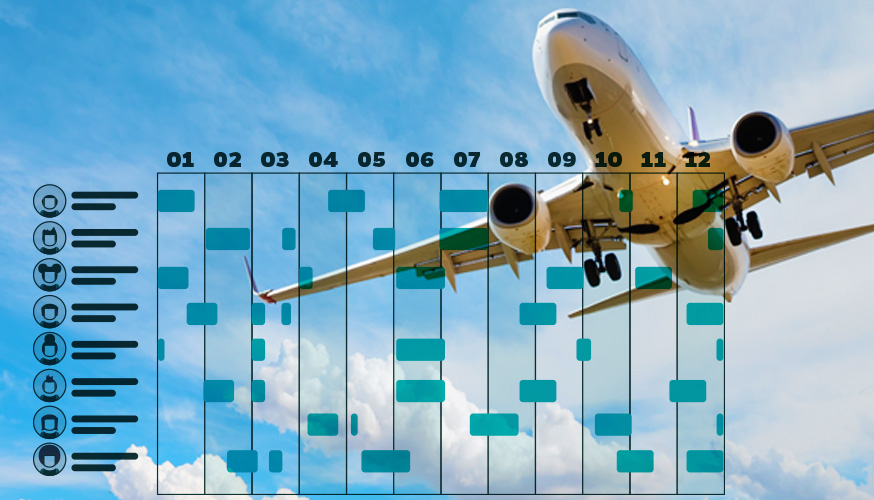
Airport operations place additional demands on workforce management: round-the-clock operations require 24/7 shift models to harmonize seamlessly with holiday planning so that shift handovers, rest periods, and minimum staffing levels are always met. Seasonal fluctuations mean that holiday periods – such as during school holidays or the summer peak season – can also be critical peak times; This requires forward-looking capacity planning, restricted periods, and graduated prioritization rules. In addition, there are strict safety and qualification requirements: Only employees with valid certificates and up-to-date training may perform certain services, which is why skill management, certificate monitoring, and qualification-based substitution rules must be an integral part of annual vacation planning.
Conclusion
Good planning lifts the mood.
Annual vacation planning for airport staff is a mixture of strategy, flexibility, and team spirit. Those who understand why it is so complex, who organize it early on, and who communicate openly ensure greater fairness, less stress, and a satisfied team, which has a direct impact on the entire operation.
Because at the end of the day, well-rested staff not only make the airport safer, but also more human. And in an environment characterized by technology, time pressure, and international hustle and bustle, that is a valuable contribution that is often underestimated.
Would you like to learn more about workforce management with plano?
Further information about our workforce management software and its
areas of application can be found here:
→ Workforce Management from plano




Archive
3 Systems - One Solution
We’re Here for You